En este módulo, aprenderás a expresar la ubicación de algunos lugares públicos. Para que puedas lograr esta descripción de lugares es importante que conozcas vocabulario relacionado a lugares públicos, regiones y áreas geográficas, preposiciones de lugar y medios de transporte.
También es indispensable repasar algunos temas como el verbo To Be, artículo definido y el uso de there is/there are. Lograrás manejar estos temas a través de información y ejercicios que también te van a ayudar a reforzar tus habilidades auditivas, de lectura, escritura y comunicativas.
Imagina que vas de vacaciones a un país en el extranjero donde hablan inglés y quieres llegar un lugar en particular ¿Qué preguntas realizarías? ¿Cómo describirías el lugar a dónde quieres llegar?
*Para comenzar, haz clic en el botón para descargar el vocabulario de este módulo.
Tarea integradora del módulo 3 FORO TM3.4 Describe your hometown
Descripción de la tarea
FORO TM3.4 Describe your hometown
Publica en el foro de la plataforma, un pequeño párrafo de entre 50 a 70 palabras en donde describas la comunidad, colonia o ciudad en donde habitas. En el desarrollo de la actividad, debes tomar en cuenta las siguientes preguntas para guiar tu texto.
Where do you live?
What buildings and places are there?
Are there any… (cinemas)?
What transportation do you use?
Do you like living there?
Why?
También puedes tener como ejemplo el desarrollo de la Activity M3.15.
*Haz clic en cada pestaña para leer la información.
La publicación de esta actividad deberá ser en el foro indicado con el título FORO TM3.4 Describe your hometown.
Lee y comenta en inglés al menos 3 publicaciones de tus compañeros.
No olvides colocar un saludo y una despedida, así como tu nombre completo en la redacción de tu tarea y en los comentarios que realices a tus compañeros.
Considera los elementos contenidos en la Rúbrica.
Realiza la actividad dentro del periodo marcado en el calendario de actividades.
Toma en cuenta la información que te presenta la rúbrica de evaluación para el desarrollo de tu tarea (task), entrega en tiempo y forma.
Rúbrica para calificar la Task M3.4 FORO TM3.4 Describe your hometown
Criterios de evaluación
1.5 Excelente
1.0 Suficiente
0.5 Insuficiente
Contenido de la información
El alumno utiliza ideas claras, precisas, enfocadas en el tema y con una extensión de 50 a 70 palabras.
El alumno utiliza en su mayoría ideas claras, precisas, enfocadas en el tema y con una extensión de 30 a 40 palabras.
El alumno utiliza sólo algunas ideas claras, precisas, enfocadas en el tema y con una extensión de 10 a 20 palabras.
Estructura gramatical
Se hace uso de la descripción contestando las preguntas de guía de manera correcta.
Algunas veces se hace poco uso de las preguntas de guía para redactar la descripción.
Se hace poco uso de las preguntas de guía para redactar la descripción.
Presentación de la información
La información se presenta de manera ordenada, clara y aplica correctamente el vocabulario visto en el módulo.
La mayoría de las veces la información se presenta de manera ordenada, clara y aplica correctamente el vocabulario visto en el módulo.
Se encuentra dificultad para comprender la información presentada.
Ortografía
Todas las palabras están escritas correctamente.
Las palabras tienen un mínimo de error en su escritura (3-5 palabras).
El mayor número de palabras presentan errores.
Task M3.5
Tarea integradora del módulo 3 Trabajo en la plataforma EMINUS
Descripción de la tarea
En el apartado de Exámenes de la plataforma educativa Eminus; identifica la actividad con el nombre Task TM3.5 Lost in the City! y resuelve los ejercicios que se presentan.
Realiza esta actividad dentro del periodo marcado por tu facilitador.
Activity M3.15
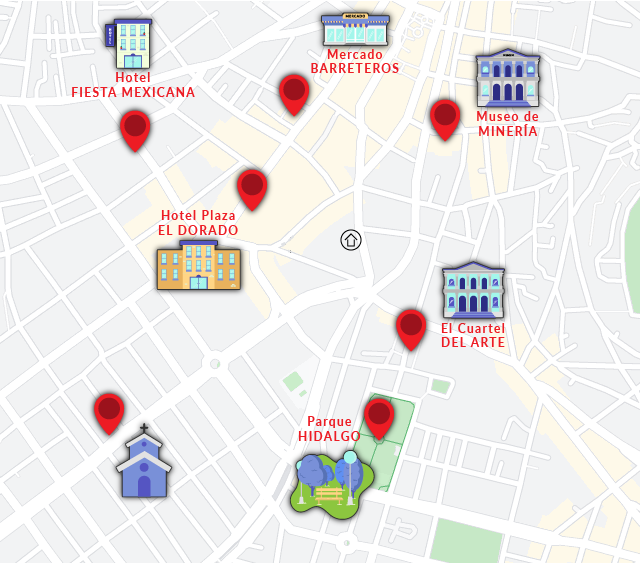
*Observa el mapa, los lugares y su ubicación, úsalos como guía para completar el texto.
I live in Veracruz, near my house there is 1)
market: 2)
, there 3)
, three hotels: Hotel Misión Express Pachuca, 4)
and 5)
, and there 6)
a park called 7)
. There 8)
two museum: 9)
and 10)
, and there is a church, too. I love the beaches and the shopping centers in my city.
Por favor, selecciona todas las respuestas.
Revisa tus respuestas e inténtalo de nuevo.
¿Cómo te fue en la resolución de la actividad anterior? Recuerda que si tienes dudas deberás consultar los materiales de aprendizaje que te presentamos en cada uno de los temas que contiene este módulo.
3.1 Artículo Definido “The”
A través de este tema, aprenderás a utilizar el Artículo Definido “THE” que te será de utilidad en cualquier contenido.
¿Revisaste el vocabulario del módulo? ¡Vamos a recordarlo con la siguiente actividad!
Activity M3.16
*Ordena las letras para formar nombres de lugares.
Letras
Palabra
miaquaru
edgarn
hrttaee
efcfio
dsmutai
ywsuab
ngidilub
rmeosotr
Letras
Palabra
karp
lhtoe
semumu
oolhcs
pdlnauyogr
nsttioa
lacadrthe
Por favor, escribe todas las respuestas.
Revisa tus respuestas e inténtalo de nuevo.
¿Cómo te fue con el repaso del vocabulario? Te recomendamos practicarlo constantemente para que puedas utilizarlo en las siguientes actividades.
Ahora estudiaremos el tema relacionado a la utilización del Artículo Definido.
El Artículo Definido es la palabra THE. Se usa antes de un Sustantivo (singular, plural, contable o incontable) para describir a alguien o algo específico o único.
Cuando utilizar THE:
Usa THE después de que has hablado de algo previamente:
This is a dog. THE dog is brown.
Usa THE cuando la persona con la que estás hablando ya sabe de lo que hablas:
I go to THE bank.
Usa THE cuando hables acerca de lugares en general, tales como lagos, montañas, oceano, playa, etc.
I like THE beach; I love to see THE mountains.
Usa THE cuando hables acerca de cosas que son únicas: The sky; The earth.
Cuando NO utilizar THE:
No utilizas THE cuando hablas de cosas en general:
I like THE ice cream. THE Math is difficult.
No utilizas THE para países, nombres propios, ciudades: THE Mexico. THE Mr. Brown. THE Veracruz.
Diferencia entre A – AN – THE
A
Se usa “A” antes de un Sustantivo Singular Contable (persona, animal o cosa) que NO sea específica: a boy, a dog, a class.
Si una palabra comienza con una consonante (b, c, d, f, g, h, j, k, etc.), se usa el Artículo “A” antes de ese sustantivo.
AN
Se usa “AN” antes de un Sustantivo Singular Contable (persona, animal o cosa) que NO sea específica: an author, an elephant, an hour.
Si una palabra comienza con una vocal (a, e, i, o, u) se usa el Artículo “AN” antes de ese sustantivo.
THE
Se usa “THE” antes de cualquier Sustantivo (contable, incontable, singular, plural) para describir algo específico o único: the moon, the world, the Sun.
Activity M3.17
*Escribe “a”, “an”, “the” o “ninguno” (x) en cada enunciado según corresponda.
1.
Nile river is in Egipt.
2.
Is there
air conditioner in your classroom?
3.
A: Where are
students? B: They’re in
library.
4.
There is
blackboard and
eraser.
5.
Children like
candies.
6.
Is there
aquarium in your city?
7.
Where is
Mexico city?
8.
Miss Roberts is
Math teacher.
Por favor, escribe todas las respuestas.
Revisa tus respuestas e inténtalo de nuevo.
Recapitulación del tema
En este tema, revisaste cómo utilizar correctamente el artículo definido “THE”. Ahora puedes distinguir en qué momento es adecuada su aplicación, también revisaste el vocabulario del módulo y las frases que se utilizan para describir lugares. No olvides que pondrás en práctica este nuevo conocimiento para el desarrollo de tu actividad de Task del presente módulo.
3.2 Localización de lugares públicos
En este tema aprenderás a expresar la ubicación de algunos lugares públicos.
Recordemos el vocabulario:
Activity M3.18
*Relaciona los lugares de la columna izquierda con la descripción de la derecha.
1. Bookstore
2. Airport
3. Gym
4. Hospital
5. Church
6. Cinema
7. Bank
8. Library
9. Supermarket
10. Restaurant
A. You can buy some things to eat here.
B. This is a place where you can study.
C. You can eat and drink here.
D. You can go here to travel by plane.
E. A place where you can get money.
F. We can watch some movies here.
G. A place where you can buy books.
H. This is a building similar to a cathedral.
I. You can go here when you feel bad.
J. This is a place where you can exercise.
Por favor, escribe todas las respuestas.
Revisa tus respuestas e inténtalo de nuevo.
Por favor, escribe todas las respuestas.
Revisa tus respuestas e inténtalo de nuevo.
Preposiciones de lugar
Las utilizamos para localizar o describir la ubicación de lugares públicos.
*Haz clic en cada recuadro para leer la información.
Next to
Where is the park?
The park is next to the museum.
On
Where is the book?
The book is on the table.
Across from
Where is the library?
The library is across from the hotel.
Behind
Where is the cat?
The cat is behind to the door.
Between
Where is the movie theater?
The movie theater is between the shoe store and the supermarket.
In
Where is the book?
The book is in the box.
In front of
In this picture there is a mailbox, where is it?
The mailbox is in front of the house.
On the corner of
Where is the hospital?
The hospital is on the corner of Main Street and Second Avenue.
Activity M3.19
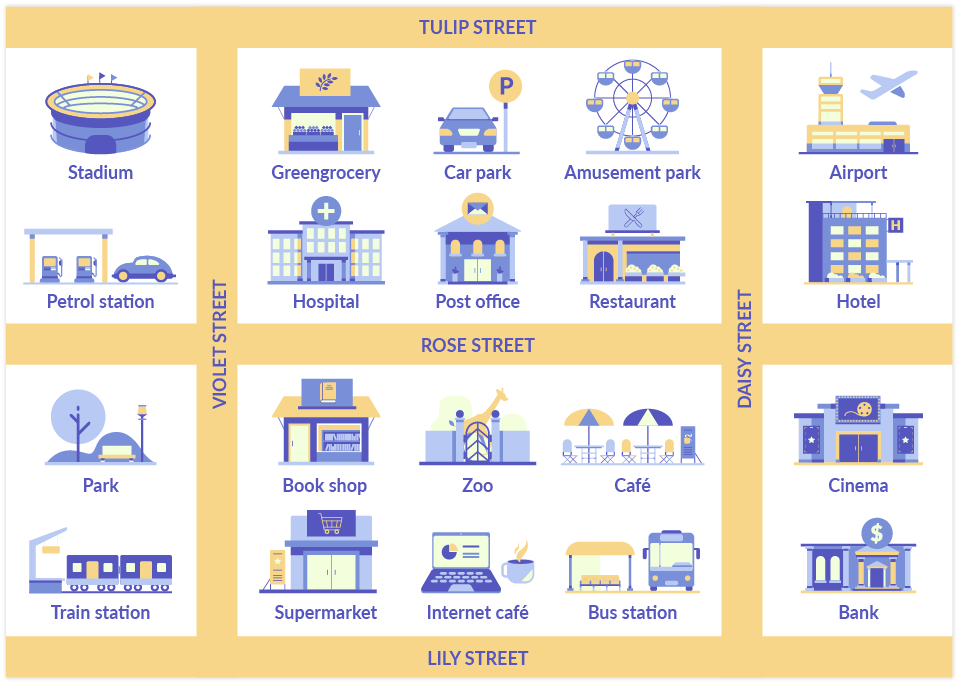
*Observa el mapa y elige una de las preposiciones para completar los enunciados.
1. The train station is
Lily Street.
2. The book shop is
the internet café.
3. The stadium is
the petrol station.
4. The car park is
the amusement park.
5. The bus station is
the bank.
6. The train station and the park are
Violet Street.
7. The Internet café is
the bus station.
8. The bank is
the cinema.
9. The post office is
the hospital and the restaurant.
10. The restaurant is
Rose Street and Daisy Street.
Por favor, selecciona todas las respuestas.
Revisa tus respuestas e inténtalo de nuevo.
Recapitulación del tema
En este tema, has conocido diferentes formas para describir o realizar indicaciones de ubicación de un lugar público, utilizando las preposiciones de lugar. Recuerda practicar en cada oportunidad que tengas para que incluyas en tu actividad del módulo estas nuevas preposiciones y vocabulario.
3.3 Verbo “TO BE”: There is – There are
En este tema, aprenderás a utilizar el verbo “To Be” (is/are) en combinación con “There” para expresar la ubicación de algunos lugares públicos.
*Haz clic en las flechas para leer la información.
Presta atención a la siguiente tabla acerca del verbo "To Be".
Pronoun
Affirmative
Interrogative
Answers
I
I am
Am I?
Yes, I am. / No, I’m not.
You
You are
Are you?
Yes, you are./ No, you aren’t.
He
He is
Is he?
Yes, he is. / No, he isn’t.
She
She is
Is she?
Yes, she is. / No, she isn’t.
It
It is
Is it?
Yes, it is. / No, it isn’t.
We
We are
Are we?
Yes, we are. / No, we aren’t.
You
You are
Are you?
Yes, you are. / No, you aren’t.
They
They are
Are they?
Yes, they are. / No, they aren’t.
Ahora observa la información acerca de “There is – There are”.
Positive
There
is
a gas station.
Singular
are
two pubs.
Plural
Negative
There
isn’t
a bank.
Singular
aren’t
any gyms.
Plural
Interrogative
Answers
Is
There
a theater?
Yes, there is. / No there isn’t.
Are
any cinemas?
Yes, there are. / No, there aren’t.
Ahora observa la información acerca del uso de “There is – There are” y algunos ejemplos.
Las expresiones there is y there are hablan de la existencia o no existencia de las cosas, como en español "hay", utilizando there is en singular y there are en plural.
Para escribir oraciones Afirmativas en singular usamos "there is" (con sustantivos singulares e incontables).
Ejemplos:
There is an airport in the city.
There is a bus on the street.
There is a gas station behind the building.
There is a bus stop on the corner of Main Street and Second Avenue.
There’s an apartment between the café and the pizza restaurant.
Para escribir oraciones Afirmativas en Plural usamos "there are" (con sustantivos en plural).
Ejemplos:
There are three cars in the garage.
There are six stores on this street.
There are some people outside.
There’re two new students in class.
Recuerda: ¡"People" es un sustantivo en plural! En singular, se dice "Person". Hay varios plurales irregulares en inglés que se revisaste el módulo anterior.
Para hacer la Negación, se usa isn’t/aren’t, y el sustantivo en singular o plural, según corresponda.
Ejemplos:
There isn’t any food in the fridge.
There aren’t any cats in the living room.
There isn’t a church near here.
There aren’t any shops on this street.
There isn’t a cinema in my town.
There aren’t any cookies students.
Las oraciones Interrogativas se hacen colocando el verbo Is o Are al principio de la frase, y la respuesta corta se hace repitiendo las mismas palabras en singular o plural, positivo o negativo, según el caso.
Ejemplos:
Are there any shops on this street?
Yes, there are. / No, there aren’t any.
Is there a bookstore near here?
Yes, there is. / No there isn’t.
Are there any people on the train?
Yes, there are. / No, there aren’t any.
1 / 3
*Haz clic en el botón para descargar la información
*Completa los enunciados utilizando “is” o “are”, según sea el caso.
1.
There
a school opposite the museum.
2.
There
some parks in my city.
3.
There
a library, two stores and a supermarket on this street.
4.
There
a bank near the subway station.
5.
There
two boards in this classroom.
6.
there a post office near your house?
7.
there any hospitals in your town?
8.
Where
the restaurants in this city?
9.
a cinema around here?
10.
Excuse me, where
the gas station?
Por favor, escribe todas las respuestas.
Revisa tus respuestas e inténtalo de nuevo.
Activity M3.21
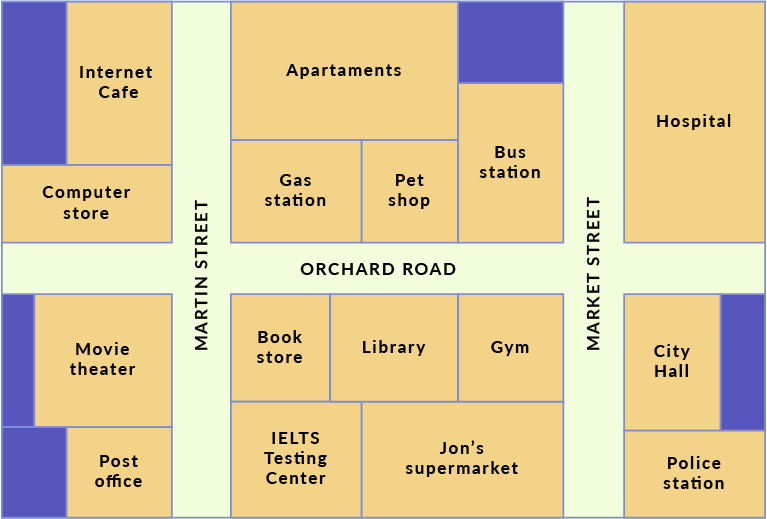
*Observa el mapa y selecciona si el enunciado es verdadero o falso.
TRUE
FALSE
1. There is an internet café is across from the movie theater.
2. The gas station is next to the pet shop.
3. The IELTS Testing Center is on the corner of Martin Street and Orchard Road.
4. Jon’s Supermarket is on Market Street.
5. There are some apartments behind the police station.
6. The post office is on Orchard Road.
7. There is a pet shop between the gas station and the bus station.
8. The City Hall is on the corner of Market Street and Orchard Road.
9. The bus station is across from the hospital.
10. There is a library between the gym and the City Hall.
Por favor, selecciona todas las respuestas.
Revisa tus respuestas e inténtalo de nuevo.
Activity M3.22
*Selecciona la forma correcta: “there are”, “is there”, “there is”, “are there”, para cada enunciado.
1.
some schools near here.
2.
a library next to the park.
3.
a bus stop near here?
4.
How many students
in your class?
5.
Yes,
a supermarket next to the movie theater.
6.
A parking lot?
one on the corner of Main and Second.
7.
some restrooms in the bus station.
8.
any shops near your house?
Por favor, selecciona todas las respuestas.
Revisa tus respuestas e inténtalo de nuevo.
Activity M3.23
*De acuerdo al texto, relaciona ambas columnas según corresponda.
THE PLACE WHERE I LIVE
My name is Sandy and I live in Hilltown, in the south of England. It is a big and beautiful town. About 9,000 people live here.
There are many shops in this town and there are three supermarkets near my house. You can buy everything that you need here. There are two banks and a post office on Main Street. You can see a big market and buy fresh fruit, vegetables, meat and many other things.
There are three churches in the town center and there is a hospital, too. You can find some good restaurants and there are five cafés. My favorite café is Heaven, on Park Street, and the ice cream is fantastic here.
There are three schools and one university. My school is on Ivory road. We have a very nice building. Next to my school there is a sports center. Every Wednesday we play tennis there.
I like living in Hilltown because it is a beautiful place and people are very friendly!
1. Hilltown is in
2. You can buy what you need in a
3. On Main Street there are
4. In the town center there are
5. Sandy’s favorite café is
6. The sports center is
7. They play tennis on
A. Wednesday.
B. next to the school.
C. two banks and a post office.
D. supermarket.
E. Heaven.
F. the south of England.
G. three churches and a hospital.
1. Hilltown is in
2. You can buy what you need in a
3. On Main Street there are
4. In the town center there are
5. Sandy’s favorite café is
6. The sports center is
7. They play tennis on
Por favor, relaciona todos los enunciados.
Revisa tus respuestas e inténtalo de nuevo.
Por favor, relaciona todos los enunciados.
Revisa tus respuestas e inténtalo de nuevo.
Recapitulación del tema
Recordamos la utilización del verbo TO BE y agregamos There is y There are, que te serán de mucha ayuda al momento de realizar descripciones de lugares públicos o dar indicaciones de lugar. Recuerda utilizar esta nueva información en tu tarea modular.
Recapitulación del módulo
A través de este módulo, has repasado diversos temas tales como el Verbo TO BE, el uso de there is / there are, preposiciones de lugar, artículo definido, vocabulario de lugares públicos y medios de transporte. Todo esto con la finalidad de poder integrar esta información, lograr entender y dar indicaciones relacionadas a la ubicación de lugares en una ciudad.