
Language as a System Unit 1. Sounds
Unit 1. Sounds
Competence: Identify some of the characteristics that sounds provide the language with and the elements of the language system taking part in pronunciation.

Presentation
In this unit, we will explore a little bit of the world of sounds: what they are, how they are produced, and some of their features. Keep in mind that the intention, for this and all
units, is not to throw you loads of information
about the topic, but just deal with the most significant issues to hopefully make you more
aware of the elements of the language system, in this case, the ones regarding
pronunciation.
To be assessed in this unit, you will have to send on due time the portfolio
activities, participate in the forum discussions, and include your insights on the unit topic in a short essay.
Introduction
A sound can be defined as “the particular auditory effect
produced by a given cause” (wordreference.com). Evidently, there are different kinds of
sounds as there are different causes that produce
them. As language teachers, and for the purposes of this course, it is the sounds that we
produce with our speech organs that we are interested in. The minimal unit of utterances in
a language system is the phoneme. When we put them or string them together, we can produce utterances that express meanings and communicate, and which have what is called suprasegmental features, that is, stress and intonation.
Counselling
You can ask for personal counselling for this unit every time you finish a topic. I’m eager to hear your questions and comments, so don’t hesitate to get in touch!
Now, we’re ready to get started, aren’t we?
Getting started
Before you start this unit, drag the following words to the most appropriate category:
Then, check the correct answers. How many did you get right? How many did you get wrong? Focus on the ones you got wrong (if that is the case) and see if you have an idea of why they were wrong. After you finish the unit, try doing this activity again.
1.1 Phonemas
As mentioned before, a phoneme is the minimal unit of utterances produced in order to communicate a message using a language system, that is, sounds within a language. Although it is a minimal unit, a phoneme does not lack importance. A single phoneme may usually lack of meaning, but a single phoneme can be the difference in meaning for words. This is what happens with minimal pairs.

Stop and think
The following are two kinds of minimal pairs. Can you tell what the difference is?.
Phonetic symbols chart
The following is a chart with the phonetic symbols that correspond to the vowel and consonant sounds:
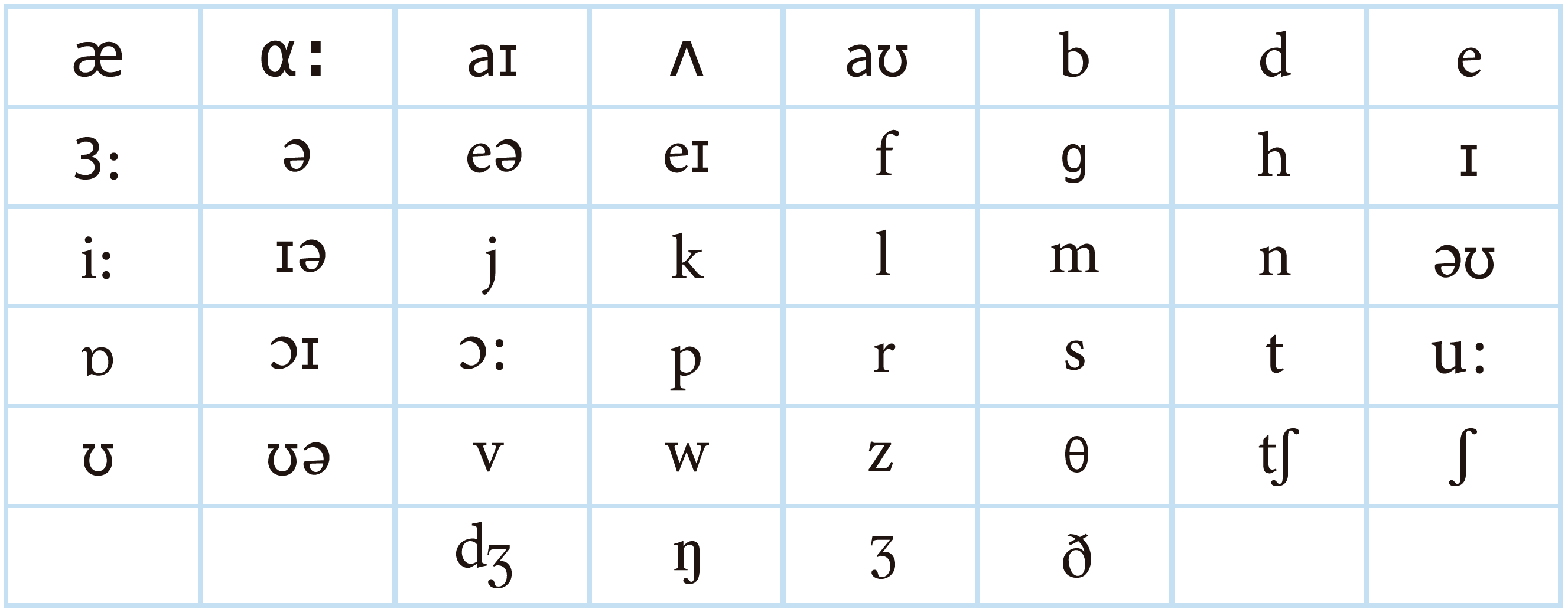
 Activity 1. LAS 101 Phonetic symbols chart
Select a category: vowel, diphthong or consonant. Then, click on the corresponding symbol for each word.


As you can see, vowels can occur as a single sound or as a combination of sounds, such as diphthongs, which involve one vowel sound moving to another one. When the combination involves three vowel sounds, then we are talking about triphthongs. The following link provides some extra information about the phonemic chart and how it can be used to help with pronunciation: http://www.macmillanenglish.com/pronunciation/interactive-phonemic-charts/#british-englis
Click on the arrows to continue reading the information.
Single vowels sounds can be classified in short and long. Taking the words from the table in Activity 1, these are examples for short and long vowel sounds:
Short
Hit
Book
Left
About
Hat
Run
Dog
Long
Bead
Food
Shirt
Call
Far
Stop and think
How are long vowel sounds indicated in the phonetic symbols?
They are indicated with the symbol / : /
While vowels are all voiced sounds, consonants are classified in two different categories: voiced and unvoiced. The difference between voiced and unvoiced is that to produce a voiced sound you make the vocal cords in the larynx vibrate. There are nine voiced consonant sounds, from which eight have a very similar unvoiced pair. The consonant sound ‘h’ is voiced, but it does not have a similar unvoiced pair.
Stop and think
From the following pairs of consonant sounds, which one is voiced and which one unvoiced?
The voiced-unvoiced component is not the only element to take into account for producing sounds. To produce different vowels, for example, which are all voiced sounds, you have to move your lips to modify the shape of your mouth, and place parts of your tongue (front, back, or centre) at different positions in your mouth (close, mid, or open, regarding the distance between your tongue and the roof of your mouth).
With regard to consonant sounds, there are two other aspects to consider: the manner and the place of articulation. Manner has to do with how much air passes through the vocal tract, and place refers to the movements of the articulators – lips and tongue – in relation to teeth, alveolar ridge, palate, and vocal cords. These are some of the parts of the body that constitute the organs of speech.
Activity 2. LAS 102 Organs of speechThere are 8 organs of speech and 3 parts of the tongue that have been mentioned.
Go back in the unit and take notes of them and then complete their corresponding names in the following chart. There are answers that fit more than one space.
There are other parts of the body that are also organs of speech, and many other issues about phonemes, but this information is enough to get an idea of how ‘things’ work so that we can produce sounds.
For further concise information related to these issues, you can consult chapter one in Kelly, G. (2000) How to Teach Pronunciation.
Stop and think
Do you think phonemic symbols are useful? In what ways? How necessary is it for an English teacher to be familiar with phonemic transcription?
Activity 3. LAS 103 Phonetic symbols and examples (PORTFOLIO)Write your own examples for each of the phonetic symbols (go to a dictionary to check your examples).


Write an answer, please.
Once you finish this activity, save it as PDF, name it Portfolio LAS 103, and upload it in Eminus in the corresponding section in ‘Actividades’.
Activity 4. LAS 104 Self-evaluation 1
Complete the following summary with one or two words. Once you finish, you may go back and check again the course material.
1.2 Strings of sounds
Stop and think
What do you understand by assimilating sounds? What about eliding or linking them?
Assimilation
This phenomenon consists in simplifying speech by making ‘neighbouring sounds’, as called by Dalton and Seidlhofer (1994, p. 28), more alike. When we put sounds together, we combine them in many different ways, that is, they are not always followed by the same other sounds. This means that when producing a sound in connected speech, its ideal position of the articulators does not always start or finish at the same point. This will happen even when speaking at a normal speed; therefore, it is common that sounds be ‘adapted’ so they can be produced more easily and make the connected speech more fluent. This may happen within or between words, but never at the beginning sounds of words, as they are essential to understand utterances.
The assimilation of sounds is the main responsible for the existence of allophones. The same phoneme may have different ways to be produced depending on the ‘sound environment’ they occur in. These different ways to produce the same phoneme are the so called allophones, and in English, the main phonemes which present such phenomenon are /t/, /d/, and /h/, and sometimes /n/, when followed by /k/,/g/, /m/, or /b/. When these combinations occur in connected speech, then assimilation usually takes place.
Activity 5. LAS 105 AssimilationAs follows, there are some examples where assimilation (the adaptation of a sound) takes place.
Finish the table indicating the corresponding aforementioned combinations as in the first word.
Elision
Elision, which is in this case a quite close synonym of ‘elimination’, occurs when, in connected speech, a sound that should be pronounced in theory disappears. The sound disappears because, as previously discussed, we tend to minimize the effort of articulating sounds when we speak in order to make it easier for us to pronounce them. These ‘left out’ sounds may be originally found within or between words, and in English, they are most commonly weak vowel sounds, such as the schwa (/ə/), or the consonants /t/ and /d/.
Activity 6. LAS 106 ElisionIndicate the phoneme that is involved in elision, that is, eliminated when used in everyday conversation, in the following examples.
Linking
Linking words is an almost natural phenomenon when speaking given that we have to connect words to transmit our messages. However, the kind of connection that is referred to with this simplification method is slightly different from the necessary connection that we must give to words when speaking. In English, there are two kinds of linkings as a simplification phenomenon.
The first type of linking consists in adding a consonant sound between a word finishing in a vowel sound and another word beginning also with a vowel sound. The second type of linking occurs when the final consonant sound of a word is pronounced as if it were part of the following word, specially, but not exclusively, when this following word begins with a vowel sound. It is also possible that the first consonant of a word be treated as part of the previous word when this has a final vowel sound. This type of linking is the origin of homophonous pairs, two sets of different paired words that sound the same.
Activity 7. LAS 107 LinkingDrag and drop the following examples in the corresponding type of linking as previously explained.
*British pronunciation:
In British pronunciation, the final “r”, as in far, disappears. However, when used followed by a word beginning with a vowel sound, as in away, the sound /r/ is added. That is why it is regarded as an example of a linking simplification phenomenon.
*Now, match the following homophonous pairs.

A Little of fun
The following is a poem that can be found at http://www.ahajokes.com/eng003.html, and it has to do with sounds and “homophones strung together”.

Eye Halve a Spelling Chequer
Eye halve a spelling chequer
It came with my pea sea
It plainly
marques four my revue
Miss steaks eye kin knot sea
Eye strike a key and type a word
And weight four it two say
Weather
eye am wrong oar write
It shows me strait a weigh
As soon as a mist ache is maid
It nose bee fore two long
And eye can
put the error rite
Its rarely ever wrong
Eye have run this poem threw it
I am shore your pleased two no
Its
letter perfect in it's weigh
My chequer tolled me sew
1.3 Stress
Although most of us are aware of the concept stress, it is not easy to give an accurate definition. First, let’s consider the term syllable. At this point, all of us are surely familiar with this term. But just as stress, syllable is a concept difficult to define. We know words have at least one syllable, and we are usually able to divide a given word in our mother tongue into syllables even if we have never heard this word before.
Therefore, knowing what syllable is and knowing how to divide words into syllables appears to be a matter of a developed intuition when it comes to our mother tongue. However, we, as non-native speakers, may find it not that easy to divide English words into syllables. Still, as we have some experience using and maybe teaching the language, we are usually able to identify how many syllables English words have.
But, why is the concept of syllable so important regarding stress? Because the kind of stress we are talking about is always associated with either monosyllabic or polysyllabic words. In the latter, there is a syllable which is pronounced more loudly than the other or others, which is precisely the stressed syllable. Every language has its own rules about how to stress polysyllabic words. English is regarded by non-native speakers as a particularly difficult language because of the so many sound combinations and possibilities to stress words that it has.
Moreover, when we speak and put several words together, we stress or emphasize some words of our choice more than others. This selection usually forms patterns that give rhythm to our speech by contrasting the stressed and unstressed syllables. At the same time, these selection and rhythm affect the intended meaning of our utterances.
Stop and think
Why is it important to be aware of the concepts syllable, stress and rhythm?
Forum Stress
Go to the forum “Activity 8. LAS 108 FORUM Stress” when indicated to discuss the importance of these concepts. Comment also on the usefulness of phonetic symbols and phonemic transcription.
1.4 Intonation
Stress and intonation are both suprasegmental features. This means that they are characteristics of sounds or phonemes regarded as segments that can be analysed. These features definitely play an important role when giving meaning to our utterances. Different stress and rhythm for the same utterance can change its sense, but it is intonation that has more functions regarding meaning.
Intonation has to do with the pitch of the voice, that is, the voice going up (rising) or down (falling) when speaking. It also has to do with loudness (loud vs. soft), with length (fast vs. slow), and with pauses. Whenever we speak, we raise or lower our tone of voice, produce utterances at different speeds, and make pauses after certain chunks of sounds. This is because in this way we express a specific meaning or intention.
Therefore, we can use the same group of sounds to express different meanings by changing the rhythm, pitch and length of our utterances, and by pausing at different ‘points’ in your speech. There is a very well-known joke in Spanish that exemplifies this using the words cómo and amaneciste. Do you know it?
Stop and think
A newlywed to his wife after their first night of their honeymoon: ¿Cómo amaneciste? (with a
mellow intonation, speaking slowly and a falling pitch towards the end)
The same man, after a 25-year marriage: ¡CÓmo! (pause) ¿AmaneCISte? (with a rising pitch
towards the end, speaking fast and capital letters expressing stress)
As can be assumed, we use intonation and stress to convey different meanings in our daily lives, both consciously and unconsciously. These meanings, or information, have different functions, and according to Crystal (1987; in Dalton and Seidlhofer, 1994:49), there are six functions for intonation, which gives meaning to everything we say.
Activity 9. LAS 109 IntonationMatch the function of intonation with its definition and its examples.
Forum Intonation
Go to the forum “Activity 10. LAS 110 FORUM Intonation” when indicated to discuss the importance of intonation and give more examples of its six different functions.
Activity 11. LAS 111 Self-evaluationComplete the following summary with one or two words.
Forum Sounds
Go to the forum “Activity 12. LAS 112 Unit 1 Sounds” when indicated to share you insights on the issues of this unit. Feel free to focus on what you found the most interesting, or any aspects that caught your attention the most.
Bibliography
- Dalton, C. and B. Seidlhofer. (1994). Pronunciation. Oxford: OUP.
- Jackson, H. (1988). Words and their meanings. Harlow. Essex. Longman.
- Jacobs, R. A. (1995). English Syntax: A Grammar for English Language Professionals. Oxford: OUP.
- Kelly, G. (2000). How to Teach Pronunciation. Harlow, Essex: Longman.
- Thornbury, S. (1999). How to Teach Grammar. Harlow, Essex: Longman.
- Thornbury, S. (2002). How to Teach Vocabulary. Harlow, Essex: Longman.
- Willis, D. (2003). Rules, Patterns and Words: Grammar and Lexis in English Language Teaching. Cambridge: CUP.
Download information