
Language as a System Unit 2. Words
Unit 2. Words
Competence: Identify the features of the language system taking part in vocabulary, and, to some extent, in grammar.
Presentation
In this unit, we will explore a little bit of the world of words: what they are and some of
the different features that they can present. Remember we will be dealing with the most
significant issues to be more aware of the elements of the language system,
in this case, the ones regarding words.
To be assessed in this unit, you will have to send on due time the portfolio
activities, participate in forum discussions, and include your insights on the unit topic in a short essay.
Introduction
You might think that defining the concept of word is very easy.
Give it a try…
Have you already come up with an accurate and complete definition of
it?...
In this unit, you will realize that
word is more difficult to define than one could imagine.
Probably, this is due to the
numerous features that words can present, such as word classes, synonymy, style and
connotation, among others. To know what these numerous
features consist in will give you a better idea of what the world of words is like.
Getting started
Before you start this unit, try to match the features in column A with the corresponding concepts in column B:
Then, check the correct answers. How many did you get right? How many did you get wrong? Focus on the ones you got wrong (if that is the case) and see if you have an idea of why they were wrong. After you finish the unit, try doing this activity again.
2.1 What is a word?
As mentioned before, a phoneme is the minimal unit of utterances produced in order to communicate a message using a language system, that is, sounds within a language. Although it is a minimal unit, a phoneme does not lack importance. A single phoneme may usually lack of meaning, but a single phoneme can be the difference in meaning for words. This is what happens with minimal pairs.
Click on the arrows to read the information.
 Activity 1. LAS 201 Type or Token
Answer the following questions
2.2 Word classes
Word classes are also called parts of speech. They are important because it is one possible way to analyse how words behave in larger chunks of language, in other words, words play different roles in a text. Thornbury (2002), as well as Crystal (1995), mention eight different word classes, but they differ in one of them.
adverb, preposition, conjunction
*Sometimes, auxiliaries are also considered as a different word class.
These word classes are divided into two categories: grammatical or function words, which help to provide the sentence with a structure and consist of a closed set; and content or lexical words, which carry the meaning and are an open set, that is to say, words can be added to each word class unlimitedly.
Activity 2. LAS 202 Word Classes (PORTFOLIO)
Using the previous information and your own knowledge, complete the following diagram:
 Eg.
Eg.
Eg.
Eg.
Eg.
Eg.
Eg.
Eg.
Eg.
Eg.
Eg.
Eg.
Eg.
Eg.
Eg.
Eg.
Eg.
Eg.
Write an answer, please.
Once you finish this activity, save it as PDF, name it Portfolio LAS 202, and upload it in Eminus in the corresponding section in ‘Actividades’.
2.3 Word families
Words belonging to the same family comprise the inflexions and most common derivatives of a base word or root. Inflexions and derivatives are those words resulting from affixation, that is to say adding prefixes or suffixes to the root. Inflexions differ from derivatives in that they are only different grammatical forms of the base word resulting from adding suffixes, while derivatives are words with a different meaning from their base word resulting from adding both prefixes and suffixes.
Activity 3. LAS 203 Affixation
Using the previous information, choose the correct answer in the following chart.
2.4 Word-formation
Affixation, as mentioned before, is a process used in inflexions and derivatives, which constitute word families. Therefore, it is a process used to form new words from a root, and that is why they are also part of the word formation feature.
New words, though, are not only formed through affixation; there is also compounding,
which consists in combining two or more words into one. As they come from independent words, the
spelling of compound words varies. They
can be used as a single orthographic word, but the independent words can also be divided by a
hyphen, or they can appear as two separate orthographic words with one meaning.
Sometimes the
same compound words can take different spellings,
and some others they only occur in one of the three different possibilities mentioned before.
Other processes to form new words are blending, conversion and clipping. Blending is when two words are put together into a single orthographic word, but do not keep their original form: the first letters of one word and the last letters of another one. Conversion is the process in which the same orthographic word changes of grammatical function, for example, from noun to verb or preposition to verb. Finally, clipping is forming new words by shortening them, that is, a clipped word comes from a longer version of itself.
Activity 4. LAS 204 Word formation (PORTFOLIO)Match the different processes to form new words with their corresponding examples, and then add examples of your own.
Write an answer, please.
Once you finish this activity, save it as PDF, name it Portfolio LAS 204, and upload it in Eminus in the corresponding section in ‘Actividades’.
Activity 4. LAS 204 Word formation (PORTFOLIO)Match the different processes to form new words with their corresponding examples, and then add examples of your own.
Write an answer, please.
Once you finish this activity, save it as PDF, name it Portfolio LAS 204, and upload it in Eminus in the corresponding section in ‘Actividades’.
2.5 Multi-word units
From the previous section, we learn that even when compound words come from two independent words and may be spelt as two orthographic words, they have a single meaning when they appear together. Multi-word units work under this same basis, and although they are not considered compounds, they consist of two or more words together with a single meaning. This is why both compound words and multi-word units are considered lexemes.
Multi-word units are also known as lexical chunks. They are classified according to two characteristics: how fixed they are, in other words, if they have a fixed or a semi-fixed form; and how idiomatic they are, that is to say, if their meaning is more or less literal according to the orthographic words that form them or not.
There are many types of multi-word units. The ones that establish the structure of a sentence are called sentence frames, and when a verb and an adverb or preposition appear together as one lexeme, they are known as phrasal, multi-part or multi-word verbs. There are other chains of words with a single meaning, such as idioms and common expressions, which can also be considered multi-word units.
Activity 5. LAS 205 Multi-word unitsComplete the following chart according to the examples provided.
2.6 Collocations
Both compounds and multi-word units are forms of word association. Collocation is another kind of word association based on how frequently two words appear together. If two words are found together on a quite regular basis, then they are called collocates; for example, you do not say “make homework”, but “do homework”. Nowadays, it is easier to determine how often words occur together thanks to corpus data, or databases of text. As information for this corpus comes from native speakers’ real use of the language, it is very difficult for non-native speakers to know the correct collocates. Even the slightest change for a very close synonym can make the collocation incorrect. Therefore, collocation is one of the most problematic areas when learning English.
Activity 6. LAS 206 Collocations (PORTFOLIO)The following is a passage written in non-standard English. This is because collocations and some fixed multi-word units have not been used correctly. Rewrite the paragraph correcting these problems, which have been highlighted in bold. Once you finish this activity, save it as PDF, name it Portfolio LAS 206, and upload it in Eminus in the corresponding section in ‘Actividades’.
From the Grimsby Evening Telegraph:
A record digit of 54 teams will be competing in three sections as the
Bryants
Carpets Intermediate Snooker League reaches underway that
week. One time again
all
three sections are possibly to be verynearly contested. In Section
A, protecting champions
Mariner Automatics, captained one time again by the most successful
skipper in
the
league, John Stevens, will be the team to win.
The largest
threat is
possibly to
come from Grimsby
Snooker Club A, and P and J Builders who will have Steve Singleton at the
wheel for the initial time.
(*Adapted from Thornbury, 2002, p.7)
Write an answer, please.
2.7 Homonyms and polysemes
Homonyms and polysemes have to do with a single form and several meanings. If words have the same form, but completely different meanings, they are homonyms; and if they have the same form and somehow different but related meanings, they are polysemes. Homonyms also have other two variations. If words have the same sound, but different spelling, they are called homophones. If they have the same spelling, but different sound, they are called homographs.
Activity 7. LAS 207 Homonyms and Polysemes (PORTFOLIO)Match the kind of word with its corresponding examples, and then add two examples of each kind.
Forum A Little of fun
Go to the forum “Activity 8. LAS 208 FORUM A Little of fun” when indicated to compare your answers for this activity. Comment on the type of words and the way in which they are being used.
2.8 Synonyms and antonyms
We all have worked with the concepts of synonym and antonym since elementary school. They are certainly very useful when trying to explain the meaning of an unknown word: you can mention another more known word with a similar meaning, or one with an opposite meaning. But ‘exact’ synonyms or antonyms are really difficult to find. Many words may have similar meanings, but they cannot be used in the same contexts. Something similar happens with antonyms, as words may have more than one opposite depending on the situation in which you use them or the other words they appear with.
Activity 9. LAS 209 Synonyms and antonymsMatch all of the following adjectives with an appropriate definition.
Now, would you say the adjectives in the same letter (A-H) are synonyms? Can you sort out their relation as antonyms?
The previous activity has actually been adapted from an English coursebook exercise (Headway Advanced, Student’s Book, p. 112) which deals with synonyms and antonyms in context. The point of the exercise is precisely to make students aware of the difference between similar words in terms of use. You may say old and antique are synonyms, but can you say ‘an antique woman’? Evidently, ‘old woman’ is a better combination, but you might prefer to use ‘elderly’ depending on the situation, don’t you think?
And that is not all. Would you say that an ‘old shop’ and an ‘antique shop’ is the same? Well, they’re certainly not. And what about opposites? Are ‘old’ and ‘young’ an example of antonyms? A ‘young woman’ as an opposite to an ‘old woman’ sounds alright, doesn’t it? What about a ‘young DVD’? No way, right? A ‘new DVD’ definitely works better, but young and new cannot really be considered synonyms, can they? After all, synonyms and antonyms are not such simple concepts, are they?
2.9 Hyponyms
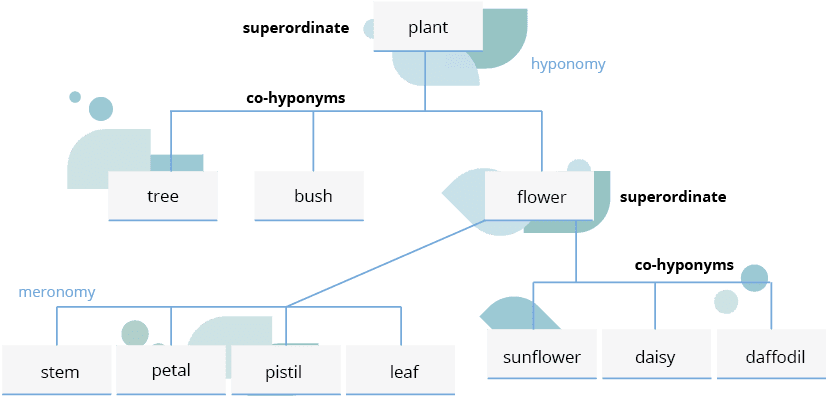
How many different kinds of fruit can you think of? Kinds of vegetables? Kinds of tools? Kinds of trees? Kinds of birds? Try making a list of kinds of drinks… Ready? Well, all of those kinds of drinks can be called co-hyponyms, because they are all a kind of drink; and this is what hyponymy refers to. In this example, the word drink is the superordinate term.
Sometimes, co-hyponyms can also be the superordinate term if there are different kinds of them. For instance, the word hat is a kind of clothing, such as shoe, T-shirt, dress, etc., and it is then a co-hyponym along with these other words; but it can also be a superordinate term for wide-brimmed hat, pill-box hat, straw hat, etc.
There is also the ‘a part of’ relation called meronymy. For example, while pill-box hat and wide-brimmed hat are kinds of hat, brim, crown and hatband are parts of a hat. Clearly, ‘a kind of’ and ‘a part of’ are very different types of relations between words, and both hyponymy and meronymy are very important to understand the kinds of relations between words and very useful as a vocabulary teaching-learning tool.
Activity 10. LAS 210 Hyponyms (PORTFOLIO)
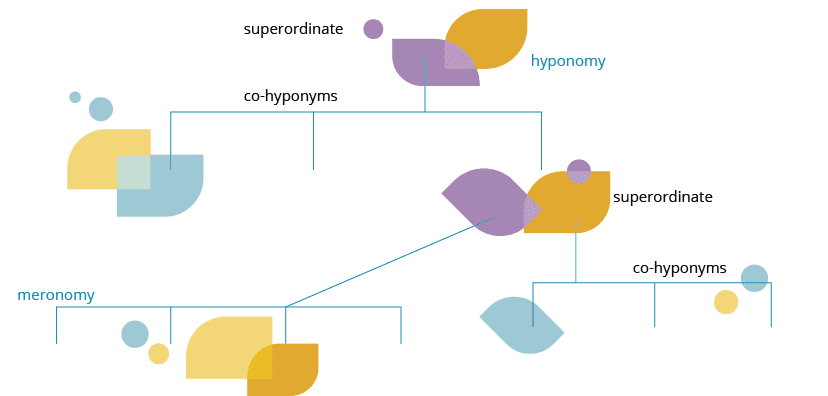
Observe the following chart and make a similar one of your own.
Write an answer, please.
Once you finish this activity, save it as PDF, name it Portfolio LAS 210, and upload it in Eminus in the corresponding section in ‘Actividades’.
2.10 Lexical fields
Just like hyponymy and meronymy are useful when it comes to teaching or learning vocabulary, lexical fields are also a handy tool for this purpose. A lexical field is the relationship between words in terms of their association with a certain theme, or, in other words, context. Usually, words belong to more than one lexical field, which is another advantage for this tool as vocabulary teaching technique: the same word + several lexical fields = more vocabulary in context.
Activity 11. LAS 211 Lexical fieldsRead the joke and decide which words belong to the lexical field ‘school’.

Blonde Test
The blonde reported for her university final examination that consists of yes/no type
questions.
She takes her seat in the examination hall, stares at the question paper for
five minutes and then, in a fit of inspiration,
takes out her purse, removes a coin and starts tossing the coin, marking the answer sheet:
Yes for heads, and no for tails.
Within half an hour she is all done, whereas the rest of the class is still
sweating it out. During the last few minutes she is seen desperately throwing the coin,
muttering and sweating.
The moderator, alarmed, approaches her and asks what is going on, and she says, "I
finished the exam in half an hour, but now I'm rechecking my answers."
Forum Lexical Fields
Go to the forum “Activity 12. LAS 212 FORUM Lexical fields” when indicated to compare your answers for this activity. Comment on other lexical fields with which you can associate words appearing in this joke.
2.11 Style and connotation
Style is usually associated with the formality or informality of words. Formal language is more commonly related to a written means of communication, while informal language is more commonly linked to spoken contexts. However, the level of formality de- pends on the situation as a whole (participants, intention, place, etc.), and not only on the means it is being used to communicate.
People choose the words they use depending on the most appropriate style to the situation in which they find themselves. Nonetheless, formality is not the only aspect to consider. People also make choices in terms of the words they use depending on their place of origin, which is known as a variety of the language. Another aspect to be taken into account is register, another variety of the language when used in specific contexts, such as legal, academic, or technical English.
Yet, one more aspect to consider is connotation. There are words with similar meanings (synonyms) that may trigger different connotations, in general classified into positive and negative. Moreover, one must be aware of the different connotations that a word may have in a given situation in order to avoid misunders-tandings and communicate successfully.
Whether it is a written or spoken means, it is important to make the appropriate word choices when using the language. Otherwise, what you intend to communicate may be awkward, inappropriate, not completely understood, or even totally misunderstood.

Stop and think
Have you ever been told that you speak in a bookish way?
Why would someone say something
like this about anyone’s way of speaking?
Activity 13. LAS 213 Style and connotation (PORTFOLIO)Read the following letter and identify the words or expressions that do not belong to this kind of context. Why are they not appropriate? Then, rewrite the letter in an appropriate style.
26 May 1997
Dear Ms Denton
Thanks for your letter of 24 May. As I am sure you will appreciate, I am most upset to learn that you were unable to locate my suitcase.
As I pointed out in my origin letter, the suitcase contained a lot of documents that I need for my job. I have to get in touch with my publishers to get hold of copies of documents that your airline mislaid. Naturally, I will complete the Claim Form, but it is not easy to guess the value of the documents. About half of them are irreplaceable.
I trust that in the meantime you continue to look for my case. Should you find it, please contact me straight away.
I am looking forward to hearing from you.
Love,
James Burke
(adapted from Soars, J and L. 1989 Headway Advanced. Student’s Book. Oxford: OUP, p. 114)
Write an answer, please.
Once you finish this activity, save it as PDF, name it Portfolio LAS 213, and upload it in Eminus in the corresponding section in ‘Actividades’.
Activity 14. LAS 214 Self-evaluationComplete the following summary with one or two words.
Forum Words
Go to the forum "Activity 15. LAS 215 FORUM Words" when indicated to share you insights on the issues of this unit. Feel free to focus on what you found the most interesting, or any aspects that caught your attention the most.
Short Essay 1
Click on each tab to read the information.

Write an essay about your insights on units 1 and 2 (Sounds and Words):
- Begin your paper with an introduction presenting what you will include in your essay in a general way.
- Summarize the topics that you found more interesting / relevant succinctly, justifying your choice of these topics in terms of your English teaching (or learning) experience (e.g. How do these topics contribute to your understanding of the sound and word systems?).
- Include a description of your experience as an English teacher (or student) in relation to the topics describing how you have dealt with them in the classroom (This is the most important part of your essay in terms of content).
- Finish with a restatement of your reasons for your choice of topics and how the contents of the unit have contributed to your understanding of them.
- Do not use any subheadings (such as 'Introduction', 'Conclusion' or any other). Just give an appropriate title to your essay.
- Use YOUR OWN WORDS. Any sign of plagiarism will render your work invalid.
Upload your file in the corresponding Activity.
Your essay will be evaluated under the following criteria:
Format requirements:
- Name your file: LAS_ShortEssay1_YourName (eg. LAS_ShortEssay1_PatriciaNúñez)
- 1 page maximum
- 280 words minimum (title and header do not count)
- On the header: your name (left margin) and the course (right margin), font Arial, size 10
- The rest of the paper: font Arial, size 12
- Appropriate title (not just the names of the units), in bold and centred
- APA style referencing (if needed)
- Margins: 2.5 cm
- Block Style: Justified, space between lines: 1.5, NO indentation in the first line of each paragraph, double space between paragraphs (NOT TRIPLE, if you are using the Word paragraph spacing, then DO NOT use double space).
- Number of words at the end (right margin) in a text box.
Bibliography
- Crystal, D. (1995). The Cambridge Encyclopaedia of Language. Cambridge: CUP.
- Jackson, H. (1988). Words and their Meaning. Harlow, Essex: Longman.
- Soars, J and L. (1989). Headway Advanced. Student’s Book. Oxford: OUP.
- Thornbury, S. (2002). How to Teach Vocabulary. Harlow, Essex: Longman.
- Woolard, G. (1996). Lessons with Laughter. England: LTP.
- What is a word? (n.d.). Retrieved from https://www.sussex.ac.uk/webteam/gateway/file.php?name=essay---what-is-a-word.pdf&site=1, on May 6th, 2007.
Download information